
ChatGPT Ads in Brazil: how it works and when it’s worth it for B2B
Updated in September 2026. All the rules, dates and numbers in this article were checked in OpenAI’s official documentation. When a number comes from a market test, and not from the platform itself, that is stated in the text.
Summary
- ChatGPT Ads is OpenAI’s advertising platform. The ad appears below ChatGPT’s answer, identified as sponsored, and doesn’t interfere with what ChatGPT answers.
- It arrived in Brazil in August 2026, with self-service through Ads Manager for companies based in the country.
- Only users of the Free and Go plans see ads and are 18 or older. Plus, Pro, Business, Enterprise and Edu subscribers don’t see them.
- There are no keywords. Targeting uses "context hints", natural-language descriptions of the situation in which your product is useful.
- Billing is per thousand impressions (CPM), per click (CPC) or per click optimized for conversion (oCPC), in an auction that weighs relevance, not just the bid. In the Brazilian panel, the minimum daily budget is R$ 40.
- Outside the US, financial, health and legal services are, in general, prohibited. In the testing phase, the platform prioritizes consumer categories, local services, digital products and education.
- For B2B, it is still a test channel, not a substitute for Google Ads and LinkedIn Ads. And it doesn’t solve the main thing: appearing in the organic answer.
What ChatGPT Ads is (and what it is not)
ChatGPT Ads is OpenAI’s ad system inside ChatGPT. When a conversation relates to what a company sells, the system may display an ad right after the answer, separate from it and marked as sponsored.
The most important point is what it does not do. OpenAI states that the ads run on systems separate from the conversation model and that the advertiser has no way to influence, order or alter the answers. You don’t buy a ChatGPT recommendation. You buy a space below it.
The other guarantee is privacy: the advertiser doesn’t receive conversations, history, memories, name, email, precise location or IP address of anyone. It receives only aggregate numbers of the ad itself, such as impressions, clicks and conversions.
Timeline: from the US test to Brazil
- February 9, 2026: the ad test begins in the United States, with a small group of advertisers and CPM buying.
- May 5, 2026: OpenAI launches Ads Manager in beta, with self-service, and starts accepting bids per click (CPC). Pixel and Conversions API enter in the same phase.
- In the following months: expansion to Canada, the United Kingdom, Australia, New Zealand, Japan and South Korea.
- August 2026: Brazil joins the list. Ads begin to appear for Brazilian users and Ads Manager starts serving companies based in the country. In the same month, conversion optimization and the multi-product format arrive.
- End of August: OpenAI announces that the ads business reached US$ 1 billion in annualized revenue in less than 200 days.
- September 2026: Sponsored Agents arrive (in testing in the US), the HubSpot integration and the expansion to Southeast Asia and Taiwan. The platform becomes available in more than 60 countries, with tens of thousands of advertisers.
Who sees the ads
Ads appear only for users of the Free and Go plans. The Plus, Pro, Business, Enterprise and Edu plans have no ads. Accounts identified as belonging to people under 18 also don’t, and OpenAI uses behavior signals, in addition to the declared age, to make this identification.
There are also no ads in temporary chats or in the ChatGPT Atlas browser, and they don’t appear near sensitive conversations, such as personal health, mental health and politics.
What the user can control
This side barely appears in the materials on the subject, and it changes how the channel is read. In ChatGPT’s settings, any user with ads can:
- hide or report an ad;
- see why an ad was shown to them;
- turn off personalization (ads then consider only the current conversation, with no history, memory or interests);
- delete the data used for ads, which leaves the servers within 30 days;
- switch to a free version without ads, accepting fewer messages per day and no access to some tools.
For those who advertise, the consequence is direct: the reachable audience is people who accept seeing ads, and the personalizable slice may shrink over time.
Where and how the ad appears
The ad appears below the end of the answer, visually separated and marked as sponsored. Each ad carries the advertiser’s name, the site icon, a headline, a short description, an image and the link to the landing page. A single unit can show more than one item from the same advertiser (multi-product format) or from different advertisers.
In September, OpenAI also launched AI text personalization: when the advertiser activates this feature, the headline and description are adapted to the conversation context and translated into the user’s language.
B2B ad example
A fictional example, for an industrial maintenance management software company. Market guides cite limits of about 50 characters for the headline and 100 for the description; confirm the limits in Ads Manager itself before producing.
- Headline: Maintenance without spreadsheets for your factory
- Description: Work orders, preventive maintenance and each machine’s history in a single system. Try it for 14 days.
- Landing page: a specific page about preventive maintenance, not the site’s home page.
Notice that the text doesn’t try to grab attention like in a social media feed. The person is already researching the problem. The ad works when it continues their task.
How the auction works
The system chooses the ad by expected relevance and probable result. The context and intent of the conversation, the landing page, the headline, the description, the advertiser’s context hints and, when the user leaves personalization on, signals from their broader use of ChatGPT enter the calculation.
Among the eligible ads, OpenAI uses a relevance-weighted second-price auction. In practice, a high bid doesn’t make up for a barely relevant ad, and a weak landing page makes the ad more expensive or takes it out of the auction.
There are three ways to buy:
- Views (CPM): pays per thousand impressions. Serves for reach.
- Clicks (CPC): pays per valid click. It is the most common option to start.
- Conversions (oCPC): the system optimizes for a conversion event, such as sign-up or purchase, but billing remains per valid click, not per conversion.
On the Brazilian account we analyzed, in September 2026, the panel offered two objectives, Reach and Clicks, and two bidding strategies: manual bid (you set the maximum value) or maximum results (the system adjusts the bid to yield the most within the budget). Conversion optimization depends on eligibility and on measurement being set up.
How to write context hints: B2B example
Context hints are phrases that explain to the system when your product is useful. They sit at the ad group level and help find the right conversations. OpenAI makes clear that they are not keywords, don’t require exact match and don’t guarantee delivery.
The official guidance is to think in three questions: what (features, service, price, service area), for whom (the customer’s need or situation) and when (the decision moment in which the offer helps). Each phrase should deal with one idea, in natural language, and not be a list of terms.
With the same maintenance software example:
- Weak: "maintenance software, CMMS, industrial maintenance, work order". It is a keyword list, and the system doesn’t work that way.
- Weak: "show only to maintenance managers in São Paulo". It is a delivery instruction, and context hints don’t apply audience, location or time filters. Location is defined in the campaign, which accepts country, region, city or ZIP code.
- Good: "Preventive maintenance system for mid-sized factories that still manage work orders in spreadsheets".
- Good: "For maintenance managers who need to reduce unplanned machine stoppages on the production line".
- Good: "Suited for when the company is comparing maintenance systems before an audit or certification".
If the use cases call for different messages or pages, the recommendation is to separate them into different ad groups.
How much it costs and how to set up the pilot budget
OpenAI doesn’t publish reference values by industry or country. What officially exists is a recommendation for per-click campaigns in the US: start with a maximum bid of US$ 3 to US$ 5 per click. Ads Manager itself indicates whether the bid tends to be competitive.
In Brazil, the panel already works in reais. What we saw on a Brazilian B2B services account, in September 2026:
- Minimum daily budget of R$ 40. Below that, the panel doesn’t accept.
- Daily or total campaign budget. The type can’t be changed after the campaign starts; the value can.
- Suggested bid of R$ 13.50 per click and suggested daily budget of R$ 47, in the campaign that Ads Manager itself built for this account.
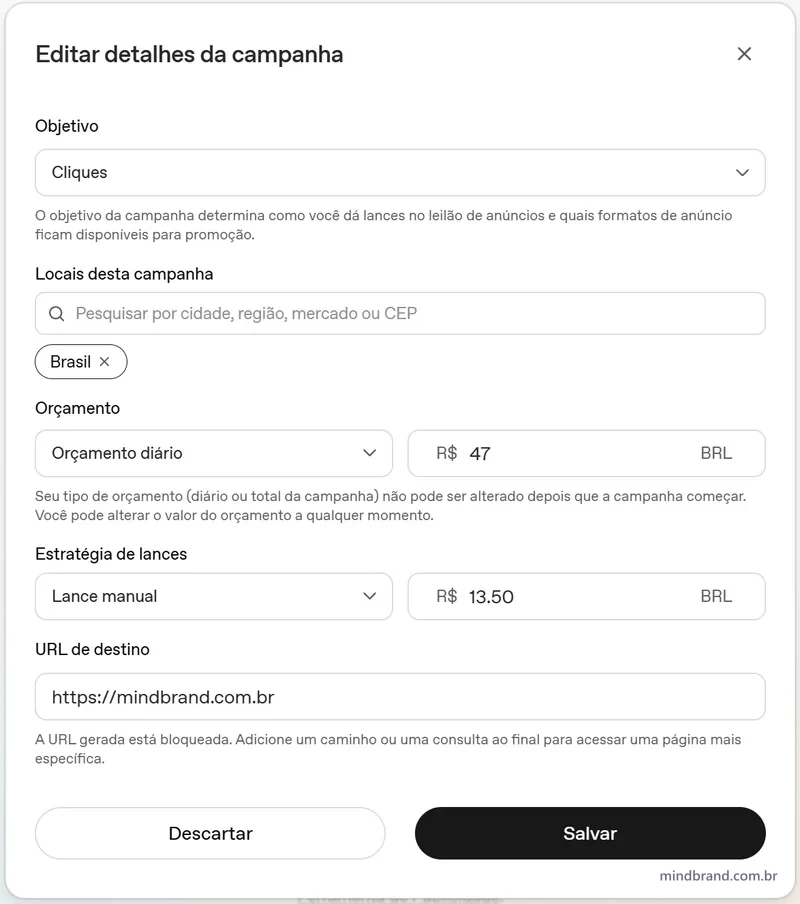
The suggested bid changes according to the category, the competition and the ad’s relevance, so treat this value as a starting point, not a fixed price.
A simple way to size the first test is to start from the number of clicks needed to learn something:
- pilot goal: 200 clicks;
- starting cost per click: R$ 13.50;
- media budget: 200 × R$ 13.50 = R$ 2,700, which comes to about R$ 90 per day over 30 days.
With the minimum budget (R$ 40 per day, about R$ 1,200 per month), that is close to 90 clicks in the month at the same bid. If 2% of clicks become a qualified contact, the 200-click pilot generates 4 contacts. It is little to conclude about return, but enough to see whether the right conversations are arriving and whether the page converts. The values are illustrative: the real cost only shows up after the campaign runs.
Two panel details: impressions, clicks and CTR update every 15 minutes, but spend can appear 7 to 8 hours late. A zeroed spend right after turning the campaign on doesn’t mean nothing was charged.
How to advertise, step by step
- Create the account at ads.openai.com. To use self-service, the company that advertises and is billed needs to be based in an available country. Brazil is on the list.
- Register the company and the payment. OpenAI verifies whether the advertiser is a legitimate company and whether the category is allowed.
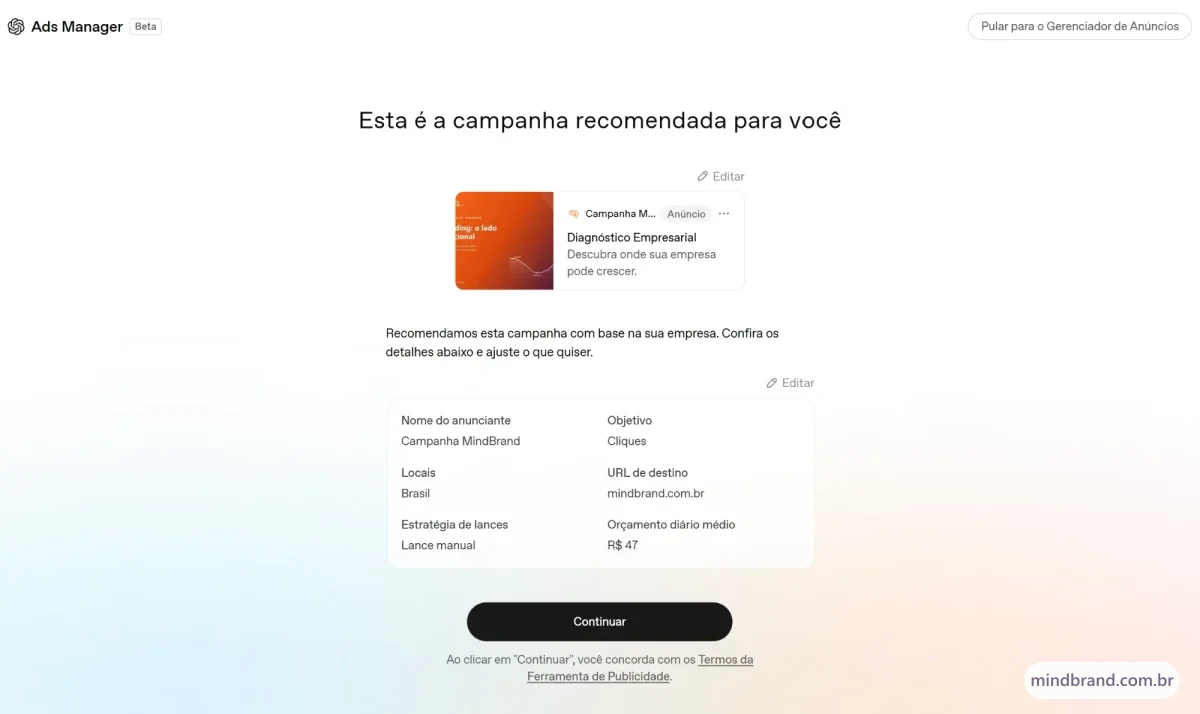
- Review the suggested campaign. Ads Manager reads your site and already proposes a ready campaign, with ad, image, budget and bid. Review everything: on the account we saw, the suggested image was the cover of a blog article, unrelated to the ad’s offer.
- Adjust the campaign: objective, locations (country, region, city or ZIP code), budget type and value, bidding strategy and destination URL.
- Create the ad groups: one topic or need per group, with maximum bid and context hints.
- Upload the ads: headline, description, image and landing page. Ads Manager already suggests texts and images from the landing page.
- Set up measurement before turning on: standardized UTM parameters on the links, OpenAI pixel on the site and, if possible, the Conversions API on the server.
- Integrate with the CRM, if it makes sense. Since September, those who use HubSpot can connect their ChatGPT Ads account, create ads, track results and handle the leads inside HubSpot itself.
How billing works
When registering the card, the bank may notify an "approved purchase" from OpenAI. According to OpenAI’s help center, it is a temporary pre-authorization to verify the card, not a completed charge. It is released automatically after verification, but may remain visible for 8 days or more, depending on the bank. The expected amount appears on the registration screen and on Ads Manager’s billing page. In September 2026, in our registration, the bank notice was US$ 50, and the amount was never charged: it didn’t appear on the card statement and the balance in Ads Manager stayed at zero.
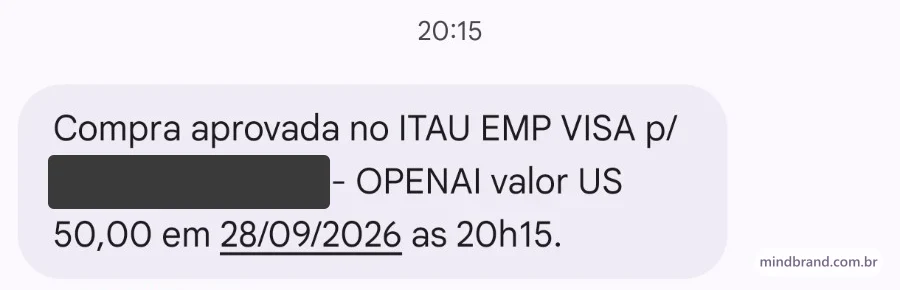
After that, billing is postpaid: spend accumulates while the ads run and the card is charged when the account reaches a payment threshold defined by OpenAI, or at the end of the month, whichever comes first. This threshold starts low, rises with payment history and can’t be changed even by support.
Watch the daily budget: it is a seven-day average, not a per-day ceiling. On a single day, the spend can reach double the daily budget, without exceeding seven times that value in the week. Self-service accounts paid by card have, for now, no daily spend limit for the whole account.
LGPD and the OpenAI pixel
This is the point that almost no content on the subject mentions. To connect the click on the ad to the conversion on your site, the OpenAI pixel reads an identifier that arrives in the link (the oppref parameter) and stores it in its own cookie, __oppref, for 30 days.
It is an advertising measurement cookie, and cookies of this type are not necessary for the site to work. The ANPD’s cookie guide treats advertising cookies as those that identify the user and build a profile from browsing. The safest reading, therefore, is to ask for consent before activating the pixel. This holds even if the site uses another legal basis, such as legitimate interest, for analytics cookies.
In practice:
- the cookie notice needs to offer the option to accept advertising cookies, and the pixel only fires after acceptance;
- the privacy policy needs to cite OpenAI as a recipient of this data and the purpose;
- for form leads, the Conversions API can send the event from the server, provided the form collects consent for this use.
This is not legal advice, and each case deserves review by your legal team. But turning the pixel on "because everyone does" is the easiest mistake to avoid.
The landing page
As the auction weighs relevance, the landing page is part of the ad. OpenAI’s policy also requires the page to accurately represent the advertiser and the offer. For traffic coming from a conversation, the page needs to:
- answer the same question that generated the click, right above the fold;
- have a single main call to action, compatible with the moment (trial, demo, diagnostic, quote);
- load fast on mobile;
- bring concrete proof (numbers, cases, certifications), because the person has just read an answer comparing options.
Ads Manager itself reinforces this: on the account we analyzed, the home page URL appeared blocked as a destination, with a request for a more specific path. And sending the click to the home page wastes the best thing the channel has: the explicit intent of whoever clicked. If your page doesn’t pass this test, the problem starts before the campaign. It is the kind of work we do in websites and pages that convert.
ChatGPT Ads x Google Ads x Meta Ads
| Google Ads | Meta Ads | ChatGPT Ads | |
|---|---|---|---|
| Where the ad appears | Above and between the results | In the middle of the feed | Below the answer |
| Signal used | What the person typed | Profile and behavior | Conversation context |
| Moment | Search for the solution | Discovery, without active search | Comparison and decision |
| Targeting | Keywords and audiences | Audiences and interests | Context hints |
| Creative that works | Direct answer to the search | Hook that interrupts | Useful continuation of the task |
| Maturity | High, with history and benchmarks | High | New, with no official benchmark |
ChatGPT Ads doesn’t replace the other channels. It fragments the journey: part of the research that used to happen on Google now happens in a conversation. Taking budget from a Google Ads campaign that works to test ChatGPT is trading the certain for the uncertain. The test should come from new budget or a small, controlled slice. If the doubt is about ads on sites and portals, see the guide to Google Display and Demand Gen. If you are still deciding between channels, see how much paid traffic costs and how we build paid media campaigns.
Prohibited and restricted categories in Brazil
This part decides whether the channel is right for your company, and most of the content in Portuguese doesn’t talk about it. Under OpenAI’s ad policy:
- Financial services outside the US are, in general, prohibited. Financial tools that don’t sell a financial product, such as management software or courses, may be accepted.
- Health services outside the US are, in general, prohibited.
- Legal services outside the US are prohibited.
- Also prohibited: adult content and dating apps, alcohol and tobacco, gambling, political content, recreational drugs, job openings and specific properties, and unproven health claims.
And there is a point that usually goes unnoticed: in the testing phase, OpenAI says the ads are limited mainly to consumer categories (lifestyle and home, local services, travel and experiences, digital products and education), with expansion planned over time. OpenAI itself uses B2B examples, such as accounting software and software for businesses, but there is no list guaranteeing each industrial or B2B services segment. Approval is done per advertiser. Before planning, confirm in Ads Manager whether your category is accepted.
Is it worth it for B2B companies?
It depends on three factors:
- It makes sense for high ticket, a product or service that requires explanation, software, a consultative sales cycle and categories where the buyer compares suppliers before talking to anyone.
- It makes little sense for low-margin products, impulse purchases, strictly local services and any category prohibited or restricted in Brazil.
- It is not a remarketing channel: the ad depends on the conversation, not on who already visited your site.
The first published B2B tests, all outside Brazil, call for caution. A Canadian agency reported 8,940 impressions, a click-through rate of 0.65% and no qualified lead. Another public test, of an SEO tool, added up to more than 97 thousand impressions, a click-through rate of 1.30% and few sign-ups. OpenAI itself says it doesn’t yet have performance benchmarks by industry or campaign type.
Is it worth entering now?
The argument in favor is familiar: a new channel usually has an auction with less competition and cheaper clicks, as happened with Instagram Stories in 2017. The argument against is equally real: there is no history, measurement is still under construction and the known B2B tests had few results.
The sensible way out is a small pilot, with a learning goal and measurement ready before the first real spent. Entering early is worth it if it is to learn with control, not to move the main budget.
An ad doesn’t replace organic presence
The ad appears after the answer. If the organic answer has already listed three suppliers and your company is not among them, the ad becomes an attempt to be reconsidered, on a screen where you were already left off the list.
That is why the right order is: first work to be cited in the answer (reference content, structured data, authority and a site readable by AI bots), then use the ad to expand reach. It is what we call SEO and GEO, and we explain the shift in the article from SEO to GEO.
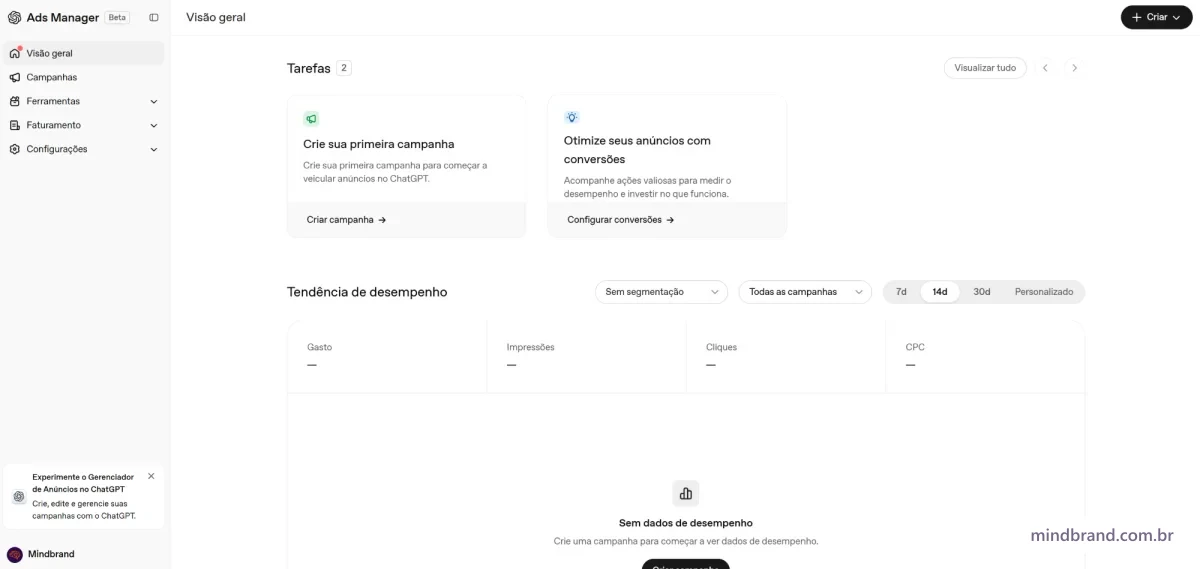
A warning about measurement: Ads Manager shows official numbers, but only for your ads, such as spend, impressions, clicks and CPC. On the organic side, no tool has access to people’s real conversations with ChatGPT, and OpenAI doesn’t publish how many times a brand appears in answers. "AI visibility" tools work with test questions or with samples of users. You can track with real data the visits that arrive from AIs and the bots’ accesses to your site, but not the count of mentions. We explain each source in how to measure your brand’s presence in AI.
Common mistakes
- Treating a context hint as a keyword: lists of loose terms, instead of situations described in natural language.
- Sending the click to the home page: the person arrives with a specific question and finds a generic storefront. The panel already asks for a more specific page.
- Accepting the suggested campaign without review: image, text and destination assembled automatically don’t always match the offer.
- Turning on the pixel without consent: an advertising cookie without acceptance is an LGPD risk.
- Measuring only the last click in a long B2B cycle: the buyer goes through several channels before talking to sales. Standardize UTMs and cross-check with the CRM.
- Taking budget from what works: the pilot comes from new budget or a small slice.
- Advertising without checking the category: finance, health and legal have their own rules outside the US.
- Expecting Google and Meta scale: the reach is still smaller and restricted to the plans with ads.
What is coming
- Sponsored Agents: after clicking the ad, the user can chat with a company agent, inside ChatGPT and separate from the original answer. It is in testing with selected advertisers in the US.
- Creation and management with AI: Ads Manager already suggests texts and images, and a plugin lets you create and analyze campaigns by commands in ChatGPT itself.
- Integrations: HubSpot (CRM) and Shopify (e-commerce) were the first. For B2B, CRM integration is the most relevant.
- New markets and formats: OpenAI says it will keep expanding countries, formats, optimization and measurement in the coming months.
Checklist before investing
- Confirm the category: is your offer accepted in Brazil at this stage?
- Test your organic presence: ask ChatGPT for the suppliers in your category and see whether your company appears and who appears in its place. It is a one-off check, not a measurement.
- Map five buying situations of your ideal customer and turn each one into an ad group with context hints.
- Prepare the landing page to answer the question that generates the click.
- Set up measurement before spending: UTMs, pixel with consent, Conversions API and CRM integration.
Glossary
- Context hint: a natural-language phrase that describes when your product is useful. Replaces the keyword.
- CPM: cost per thousand impressions.
- CPC: cost per click.
- oCPC: click optimized for conversion. The system looks for conversions, but charges per click.
- Relevance-weighted auction: the winning ad depends on the bid and on relevance to the conversation.
- Pixel: code on the site that records what happens after the click.
- Conversions API: sending conversion events straight from the server, without depending on the browser.
- Sponsored Agent: conversation with a company agent, opened from an ad.
Frequently asked questions
Can you pay to appear inside ChatGPT’s answer?
No. The ads run on systems separate from the model and appear below the answer, marked as sponsored. The advertiser has no way to influence, order or alter what ChatGPT answers.
How much does it cost to advertise on ChatGPT?
OpenAI doesn’t publish reference values. In Brazil, the panel requires a minimum daily budget of R$ 40, and on a B2B services account the suggested bid was R$ 13.50 per click, in September 2026. The real cost depends on the category, the competition and the ad’s relevance.
Is there a minimum budget?
There is no published total minimum budget, but Ads Manager in Brazil requires a daily budget of at least R$ 40 (September 2026). The daily budget is a seven-day average: on a single day the spend can reach double. The budget can be daily or the campaign total, and the type doesn’t change after it starts.
Does OpenAI charge when you register the card?
There shouldn’t be a charge at registration. The bank may show a temporary pre-authorization, sometimes as an "approved purchase", which OpenAI says is released after verification and may stay visible for 8 days or more. In our registration, the US$ 50 notice didn’t become a charge. The real billing is postpaid, according to the ad spend.
Does the advertiser see people’s conversations?
No. The advertiser receives only aggregate numbers, such as impressions, clicks, spend and conversions. Conversations, history, memories and personal data are not shared.
Does ChatGPT Ads replace Google Ads?
No. The reach is still smaller, measurement is under construction and there is no official benchmark. The most sensible thing is to test with new budget or with a small part of the budget, without dismantling what already works.
Which companies can’t advertise in Brazil?
Outside the US, financial and health services are, in general, prohibited, and legal services are prohibited. Adult content, alcohol and tobacco, gambling, political content, among others, are also not accepted. In the testing phase, OpenAI prioritizes consumer categories, local services, digital products and education.
Do I need consent to use the OpenAI pixel?
The pixel writes an advertising cookie for 30 days. The safest reading of the LGPD and of the ANPD’s cookie guide is to ask for consent before activating it and cite OpenAI in the privacy policy.
Want to know whether ChatGPT Ads makes sense for your company?
The Business Diagnostic analyzes your company’s market, competition and digital presence before any proposal, including whether your category can advertise on ChatGPT and whether your organic presence supports the investment. If you have already decided to test the channel, see how our ChatGPT Ads service works. For a broader look at acquisition, see the Generate demand solution.
Sources
- OpenAI Help Center: Ads in ChatGPT, the basics
- OpenAI Help Center: Ads in ChatGPT (users, privacy and controls)
- OpenAI Help Center: Write context hints for ChatGPT Ads
- OpenAI Help Center: Billing & Payment (ChatGPT Ads)
- OpenAI Help Center: Ads Manager availability
- OpenAI: Advertising policies
- OpenAI: New ways to buy ChatGPT ads (May 2026)
- OpenAI: Reimagining advertising with AI (September 2026)
- OpenAI: ChatGPT Ads expands to Southeast Asia and Taiwan (September 2026)
- OpenAI Developers: Measurement Pixel
- ANPD: Guidance guide Cookies and personal data protection
- Choice OMG: ChatGPT Ads field guide (market tests)