
How to measure your brand’s presence in AI: what can and can’t be done
Updated in September 2026. The information on reports and bots was checked in the official documentation of Google, Microsoft, OpenAI, Anthropic and Cloudflare. The descriptions of market tools follow what each company publishes about its own methodology.
Summary
- Nobody has access to people’s real conversations with AIs. Neither a tool nor an agency. OpenAI, Google, Anthropic, Microsoft and Perplexity don’t release this data.
- No "AI visibility" tool is official. All of them work with samples: test questions they ask themselves or panels of users who agreed to share conversations. It is a small snapshot, not a count of the market.
- Only two platforms release any official data: Google (impressions in AI Overviews and AI Mode, in Search Console) and Microsoft (citations in Copilot and Bing, in Bing Webmaster Tools). Neither covers ChatGPT.
- What you measure with real data is what reaches your website: visits coming from AIs in Analytics and AI bot accesses on the server.
- The right reading is a trend, crossing sources. An isolated "visibility" number doesn’t say how many times your brand was cited.
Our position
Let’s get straight to the point, because the market is confused about this:
- These tools are not official. None of them has access to the data of OpenAI, Google, Anthropic or Microsoft.
- They work like SEO tools. The true data is held only by whoever operates the platform. In SEO, only Google knows the real volume of each search; in AI, only OpenAI knows what ChatGPT answered each person.
- And they are worse than SEO ones. In SEO, Google itself publishes search volume, and the tools calibrate against it. In AI, no company publishes anything similar. Besides, an AI’s answer changes with each conversation, something that doesn’t happen with a results page.
- The sample is tiny compared to the real volume. A tool that talks about "260 million questions per month" impresses until you do the math: ChatGPT alone was receiving 2.5 billion questions per day in July 2025, according to OpenAI itself, about 75 billion per month, when it had half the users it has today. 260 million is less than 0.4% of that, split among several AIs. And, in some cases, they aren’t even people’s questions, but questions the tool itself created.
- And it doesn’t cover your market. The bases are concentrated in the US and in English. For the Brazilian buyer, and even more for a B2B niche, the sample may be minimal or nonexistent.
- Selling this number as if it were your brand’s real presence is almost dishonest. A "your brand has 12% visibility on ChatGPT" presented without explaining where it came from leads the client to believe in something that nobody can measure.
That is why, at MindBrand, we don’t sell "AI mention monitoring". We work with what is real (the official sources that exist and what reaches your website) and, when we use tests or tools, we call them by the right name: sample.
Why nobody can count your brand’s mentions
The question every client asks is simple: "how many times did my company appear in ChatGPT’s answers?". The honest answer is that this number doesn’t exist outside OpenAI.
The conversations stay on each AI company’s servers. OpenAI states that it doesn’t share conversations with advertisers or sell user data, and none of the major AI companies offers a public brand mentions panel. Having access to the real set of conversations would be the "holy grail" of AI marketing, and no platform releases it.
There is one more difficulty: an AI’s answer is not fixed like a Google results page. The same question can generate different answers depending on the conversation context, history, memory, location, the model used and the moment. Even those who repeat the question a hundred times are taking a photograph, not doing a count.
The same logic as SEO tools
This is not new. In SEO, Semrush, Ahrefs and other tools estimate search volume and position with their own bases, tracking and statistical models. None of them has Google’s internal data, and that is why two tools show different numbers for the same keyword without either lying. With AI the same happens, only worse: in SEO, the results page is practically the same for everyone and the tools can observe it at scale; in AI, each conversation generates a different answer, and the tool only sees the small part it asked about itself or that its panel shared.
The three data sources, from the most to the least reliable
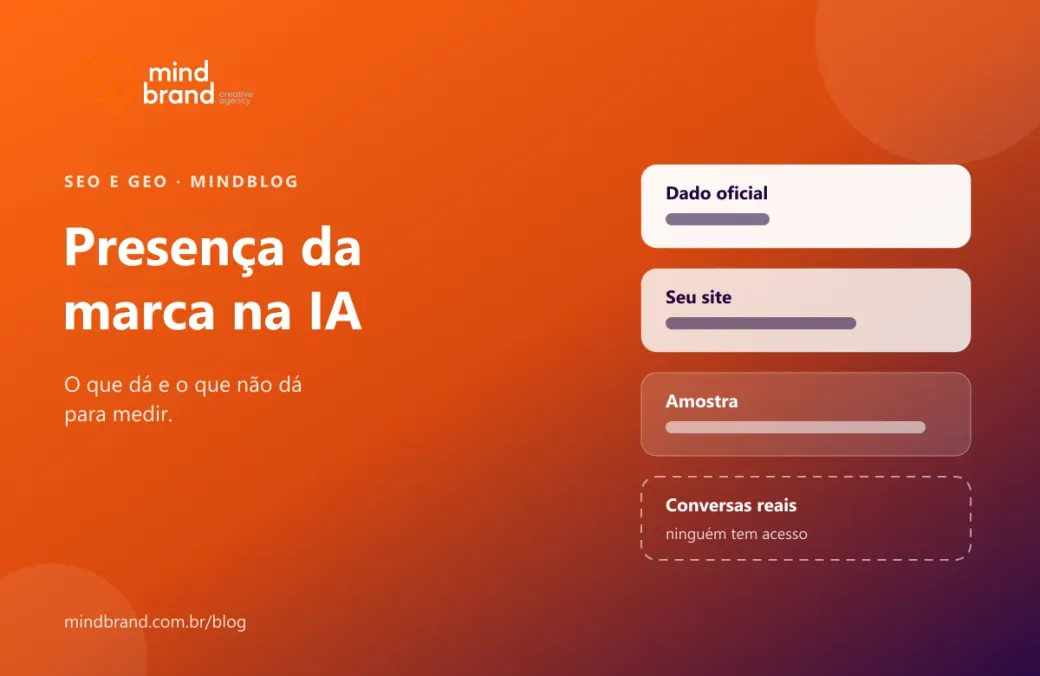
To organize what exists, we split it into three groups. Each measures a different thing and has different limits.
- Official data from the platform itself: comes from whoever operates the AI. It is the most reliable, but covers little.
- Real data from your website: what reached you. It is reliable, but only sees who clicked or the bot that visited.
- Third-party tools: samples and tests. Useful for comparing and tracking trends, never for counting the market.
Group 1: what the platforms officially release
Google Search Console: generative AI report
Announced in June 2026 and released for all sites on August 31, 2026, the generative AI performance report shows how many times links from your website were displayed inside Google Search’s AI features.
- Covers: AI Overviews and AI Mode in Google Search. Discover has a separate report.
- Shows: impressions by page, country, device and date.
- Doesn’t show: clicks, click-through rate, the questions asked or the position within the answer.
- Doesn’t cover: the Gemini app (gemini.google.com), Search Labs experiments and any AI from another company.
- Limits: the same as the regular performance report, such as the 1,000-row cap. Sites with little exposure may be left without data.
An impression means the link appeared, not that it was read or that the brand was cited in the answer text.
A real example: in the TSPro case, the site’s impressions in these features grew 90% from June to September 2026, month by month, from the SEO and technical content work. In the Fix Solutions case, the same report shows the site about 5 times more present per business day in Google’s AI answers than in May (from 19 to 94), with the caveat that the report doesn’t say how many clicks this generated.
Bing Webmaster Tools: AI Performance
In public preview since February 2026, Microsoft’s AI Performance report shows how many times your site was used as a source in AI answers.
- Covers: Microsoft Copilot, Bing’s AI summaries and "selected partner integrations", which Microsoft doesn’t name.
- Shows: total citations, cited pages, evolution over time and the grounding queries, the internal searches the AI made to find the source.
- Doesn’t show: clicks, the position or weight of the page in the answer, or the user’s original question. Grounding queries are AI rewrites, not what the person typed.
- Doesn’t cover: ChatGPT, which doesn’t appear among the services cited by Microsoft.
- Declared limit: Microsoft itself says the data represents "a sample of citation activity".
And ChatGPT, Claude and Perplexity?
For organic, nothing. OpenAI, Anthropic, Perplexity and Meta don’t offer a citation or mention report to site owners. OpenAI’s only official data for businesses is the Ads Manager’s, and it covers only your own ads: spend, impressions, clicks, cost per click and conversions. We talk about this in the guide to ChatGPT Ads in Brazil.
Group 2: what reaches your website
Google Analytics: visits coming from AIs
When someone clicks a link inside an AI answer and arrives at your website, Analytics records the visit and the source. OpenAI itself states that ChatGPT links carry the tag utm_source=chatgpt.com. The most common sources are chatgpt.com, gemini.google.com, copilot.microsoft.com, perplexity.ai and claude.ai.
It is real data, from real people, but with three flaws:
- A mention without a click is invisible. If the AI cited your company and the person didn’t click, Analytics doesn’t know.
- Part of the visits lose the source. Those who come from the app or copy and paste the link usually fall into "direct".
- AI Overviews and AI Mode get mixed. The click coming from Google Search’s AI features arrives as Google organic traffic, with no separation.
A practical tip: create in GA4 a channel group with its own channel for AI assistants, bringing together these sources. In our own GA4, the default classification left part of the visits from AIs scattered under "referral", and the custom group solved it.
Server and Cloudflare: AI bots
Google Analytics doesn’t see bots, because they don’t run the page’s measurement code. To see which AI bots access your site, the source is the server’s access log or a service such as Cloudflare’s AI Crawl Control, which shows accesses by bot and by page.
Each company uses different bots, with different functions:
- OpenAI: GPTBot (collection to train models), OAI-SearchBot (ChatGPT search index), ChatGPT-User (live search, when someone asks for something that requires opening the page) and OAI-AdsBot (ad validation).
- Anthropic: ClaudeBot (training), Claude-SearchBot (search index) and Claude-User (live search).
- Perplexity: PerplexityBot (index) and Perplexity-User (live search).
- Meta: meta-externalagent.
- Google and Microsoft: Gemini and Copilot use the regular search bots (Googlebot and Bingbot), so it is not possible to separate AI access from regular search access.
Live search bots, such as ChatGPT-User and Claude-User, are the signal closest to a real conversation: someone asked something and the AI went to fetch your page at that moment. Still, the access doesn’t say whether your brand appeared in the answer, and answers built from the index the AI had already stored generate no access at all.
It is also worth checking whether these bots can get in. We have already seen shared hosting return an error to AI bots because of the server’s own rule, with nothing in robots.txt. This doesn’t show up in Analytics and can only be discovered by testing.
The simplest question: "How did you hear about the company?"
The most direct data is still asking. A free-text field in the contact form, such as "How did you hear about the company?", captures what no report shows: the buyer who heard about you in a ChatGPT answer, didn’t click and came back days later searching for your name. We put this question in our own diagnostic form, together with the technical origin of the visit, precisely for this reason.
Group 3: "AI visibility" tools
There is a growing market of tools that promise to measure brand presence in AIs. All of them work with one of two bases: test questions, which the tool fires at the AIs and records the answers, or user panels, people who agreed to share their own conversations. See how the main ones describe their own methodology:
| Tool | Where the data comes from | What the number means |
|---|---|---|
| Profound | Panel of consumers who authorized sharing conversations, with statistical bias correction, plus own questions | Estimate from a sample, concentrated in the US |
| Semrush (AI Visibility Toolkit) | A base of hundreds of millions of prompts built with browsing data bought from third parties and Google keywords | What the AI answered to the questions Semrush asked |
| Ahrefs Brand Radar | Own questions generated from the keyword base and Google’s "related questions" | What the AI answered to the questions Ahrefs asked |
| Otterly.AI | Questions you register, run periodically | The result of your test questions |
| Peec AI | Questions you register, run in the AIs’ interface | The result of your test questions |
None of them is official, and none measures the market. When a tool says "your brand has 12% visibility on ChatGPT", that doesn’t mean 12% of real conversations cited you. It means that, in the questions that tool asked or observed, with its methodology, your brand appeared in 12% of the answers. The companies themselves describe the methodology on their pages; the problem starts when the number reaches the client without that explanation, sold as if it were the brand’s real presence.
The honest use is restricted: comparing your brand with competitors within the same tool, discovering which sites the AIs cite as a source and tracking whether the trend goes up or down. As an absolute number, it isn’t worth it.
The common limits
- A sample is not the market. Test questions are chosen by someone. A user panel is a specific group of those who agreed to take part. And the advertised volumes, hundreds of millions per month, are a small fraction of what AIs receive: ChatGPT alone passed 2.5 billion questions per day in 2025.
- Ask "of what, based on what and from what period". A number of questions only means something if you know whether they are questions from real people or created by the tool, from which countries and languages, and over what time interval.
- Coverage of Brazil and Portuguese is uncertain. A good part of the panels and bases is concentrated in the US and in English. For a Brazilian B2B niche, the sample may be very small.
- The answer changes. The tool sees the answer it received, without the history and memory of the real user.
- Each tool gives a number. As in SEO, don’t compare values between tools; compare the same tool over time.
Where panel data comes from
It is worth knowing how this kind of data can be collected. In December 2025, security researchers showed that the Urban VPN Proxy extension, with about 8 million users and a featured badge in the Chrome store, was capturing conversations with ChatGPT, Claude, Gemini, Copilot, Perplexity and other AIs, with the feature on by default, and passing the data on to a data broker. There is no relation between this case and the tools cited above. It shows, however, that a panel’s "consent" may be hidden in terms of use that almost nobody reads, and that it is worth asking the supplier where the data comes from.
Map by AI: what can be known about each one
| AI | Official data | Visits in Analytics | Bot on the server |
|---|---|---|---|
| ChatGPT | None for organic (only the Ads Manager, for ads) | Yes (chatgpt.com) | GPTBot, OAI-SearchBot, ChatGPT-User |
| AI Overviews and AI Mode | Search Console (impressions) | Mixed with Google organic | Googlebot (doesn’t separate) |
| Gemini app | None | Yes (gemini.google.com) | Googlebot (doesn’t separate) |
| Copilot and Bing | Bing Webmaster Tools (citations, by sample) | Yes (copilot.microsoft.com and bing) | Bingbot (doesn’t separate) |
| Claude | None | Yes (claude.ai) | ClaudeBot, Claude-SearchBot, Claude-User |
| Perplexity | None | Yes (perplexity.ai) | PerplexityBot, Perplexity-User |
How to set up your measurement, in practice
- Activate Search Console and Bing Webmaster Tools. They are free and are the only official sources of AI presence today.
- Create the AI channel in Google Analytics and track visits, entry pages and contacts generated by these sources.
- Allow the AIs’ search bots in robots.txt (OAI-SearchBot, ChatGPT-User, Claude-SearchBot, Claude-User, PerplexityBot) and test that the hosting doesn’t block them. Blocking training bots is your decision; blocking search bots takes you out of the answers.
- Ask "How did you hear about the company?" in the forms, in free text.
- Run your own repeatable test: a fixed set of questions from your category, asked every month on the main AIs, recording whether your brand appears, in what position and next to whom. Call it a sample, because that is what it is.
- If you hire a tool, ask where the data comes from, what the coverage is for Brazil and Portuguese, and read the result as a trend, never as the brand’s real presence.
- Cross everything by month: impressions on Google, citations on Bing, visits from AIs, live search bot accesses and answers to "how did you hear about us". No single source tells the story; together, they show the direction.
Measuring doesn’t solve it
Measurement shows the result; it doesn’t create presence. What makes an AI cite your company is the foundation work: reference content that answers your customer’s real questions, structured data, a site the bots can read and authority built on trustworthy sources. It is what we call GEO, and we explain the shift in the article from SEO to GEO.
Frequently asked questions
Is there a tool that shows how many times my brand appeared in ChatGPT?
Not with real data. OpenAI doesn’t release the conversations or a mentions report. Market tools estimate from test questions or from panels of users who agreed to share conversations, which is a sample, not the whole.
Does Google Search Console show Gemini?
No. Search Console’s generative AI report shows impressions in AI Overviews and AI Mode, the AI features of Google Search. The Gemini app is not included.
Does Bing Webmaster Tools show ChatGPT?
No. The AI Performance report covers Microsoft Copilot, Bing’s AI summaries and partners that Microsoft doesn’t name. ChatGPT doesn’t appear among them, and Microsoft itself says the data is a sample of citations.
Can AI bots be seen in Google Analytics?
No. Bots don’t run the page’s measurement code. Bot accesses appear in the server log or in services such as Cloudflare’s AI Crawl Control.
How do I separate in Analytics the visits that came from ChatGPT?
ChatGPT links arrive with the source chatgpt.com. The ideal is to create in GA4 a channel group with its own channel for AI assistants, bringing together chatgpt.com, gemini.google.com, copilot.microsoft.com, perplexity.ai and claude.ai.
Are AI visibility tools worth it?
They are not official and don’t measure the market. They serve, at most, to compare competitors and track a trend within the same tool, knowing that the number comes from a small sample concentrated outside Brazil. Be wary of anyone who presents this number as your brand’s real presence. Before hiring, ask where the data comes from and what the coverage is for Brazil, Portuguese and your niche.
Want to know how your company appears in AIs?
The Business Diagnostic analyzes your company’s market, competition and digital presence, including what can be known today about your presence in AI answers, without promising numbers that nobody has. For the work of appearing in these answers, see the SEO and GEO service.
Sources
- Google Search Central: Search Generative AI performance reports in Search Console
- Search Console Help: Generative AI performance report (Search)
- Microsoft Bing: Introducing AI Performance in Bing Webmaster Tools
- OpenAI Help Center: Ads in ChatGPT (conversation privacy)
- OpenAI: Overview of OpenAI crawlers
- Anthropic: ClaudeBot, Claude-User and Claude-SearchBot bots
- Cloudflare: AI Crawl Control
- TechCrunch: ChatGPT users send 2.5 billion prompts a day (July 2025, OpenAI data)
- Profound: Prompt Volumes (metodologia)
- Semrush: where the AI Visibility Toolkit data comes from
- Ahrefs: Brand Radar methodology
- Otterly.AI
- Peec AI
- The Hacker News: Chrome extension intercepted AI conversations (Dec/2025)