
How much SEO costs (and when it’s worth it)
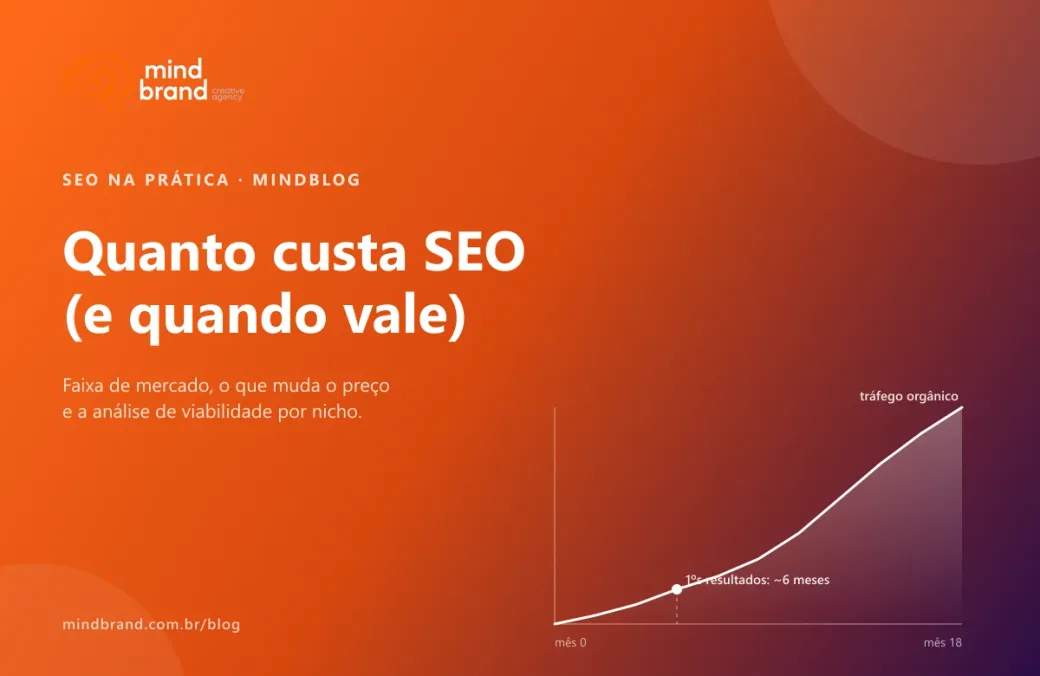
Direct answer: in the Brazilian market, SEO costs from R$ 1,000 to R$ 15,000 per month, with most SME and mid-sized company contracts between R$ 2,000 and R$ 8,000. At MindBrand the model is different: from R$ 5.50 per keyword, per day, billed monthly, and the new website, when needed, comes in the package.
But price is the second question. The first is: does SEO make sense for your case? In some niches, getting to the first page costs more than it is worth, and many agencies don’t do this math before signing the contract. This article does.
The market range (2025–2026)
The monthly fee ranges practiced in the Brazilian market (the media budget, when there is one, is always separate):
- Freelancer or generalist: R$ 1,000 – 2,500/month. Basic optimization, few deliverables, no team.
- Consultant or specialized agency (SMEs and mid-sized companies): R$ 2,000 – 8,000/month. Strategy, technical SEO, content and follow-up. It is the market standard.
- Performance agency for large operations: R$ 8,000 – 15,000+/month. Multidisciplinary team, thousands of URLs.
When the website needs technical re-engineering, most of the market charges this separately: from R$ 15,000 to R$ 40,000, one-time. The average fee cited is around R$ 2,500/month, and the most common minimum contract is 3 to 6 months.
How MindBrand charges: per keyword
Instead of a closed monthly value, MindBrand’s SEO is priced per keyword, per day: from R$ 5.50/day per keyword, which comes to about R$ 165 per keyword per month. You choose how many and which keywords to work on, and see exactly what you are paying for.
The value per keyword rises with the ranking difficulty (more on that later): the more contested the term, the more content, technical and authority work it requires.
Example: 15 low-difficulty keywords come to around R$ 2,475/month.
The package includes, when necessary, a new website, hosting, maintenance and plugin licenses. Link acquisition (off-page) is evaluated separately, depending on the niche.
Why the website is included: in most cases, the current website doesn’t have the technical foundation to sustain excellent SEO: architecture, performance, indexing control, structured data. Redoing it is cheaper and faster than patching what exists. That is why there is no "re-engineering" charged separately here: the new website is part of the work.
The contract is for 24 months: the next section explains why.
Why SEO is charged monthly (and for 24 months)
SEO is not a project that ends. It is the continuous building of three things that Google takes time to recognize: relevance (content that answers better than the competitors’), authority (other sites citing yours, see what backlinks are) and history (how satisfied those who click remain, the subject of does traffic influence organic SEO?).
There is also a mechanical reason: each change made to the website only reflects in organic after 3 to 6 months. It is the time for Google to crawl the page again, reprocess and recalibrate trust in it. The lower the domain’s authority (DA), the longer this cycle. And there are several cycles (optimize, wait for Google to respond, measure, adjust) until the position consolidates. Twenty-four months are about four of these cycles.
A short contract interrupts the work right before it pays off, and the new website, built at the start, only justifies itself with SEO running for long enough. The long term protects both sides: the agency plans the team, and the client doesn’t pay for the initial setup to reap half the result.
What makes the price of SEO vary
- Niche competition. It is the factor that moves price and timeline the most. "Labor lawyer in São Paulo" has dozens of firms with 10 years of authority competing; "manufacturer of valve for process steam" has almost nobody. The first requires a high budget for many months; the second can rank in a quarter.
- Technical state of the website. A slow, poorly structured website or one stuck on a closed platform doesn’t sustain SEO. In the market, this becomes a re-engineering charged separately; in MindBrand’s model, a new website comes in the package.
- Scope. The base is technical SEO + content + on-page optimization. Link acquisition and digital advisory are separate work, evaluated case by case; not every niche needs them.
- Seniority of those who execute. The lowest budget almost always means a junior team, generic deliverables and no ability to react to a Google update.
- Volume. How many keywords, how many pages, how many languages. An e-commerce with 5,000 products is another job, and another price, compared to a 15-page corporate website.
The analysis almost nobody does before selling SEO
Before proposing a value, you have to answer: how much time and money until the first page, and how much is that worth to the business? The answer changes completely depending on the niche, and starts by measuring the difficulty of each keyword.
The ranking difficulty scale
Every keyword gets a difficulty score, from 0 to 100, based on the strength of the sites already on the first page:
- 0–19 · easy: you can rank quickly, sometimes in a quarter.
- 20–39 · moderate: a few months of consistent content and optimization.
- 40–54 · possible: requires strong content and authority growing in parallel.
- 55–74 · hard: only with a high budget and timeline, or if the domain already has authority.
- 75–100 · very hard or unfeasible: it is almost always better to invest the money elsewhere.
This score defines the strategy and the price of each keyword, and sometimes leads to the honest answer: don’t do SEO for that term.
Where SEO is almost unfeasible in the short term
- Generic, highly contested terms in capitals: "dentist", "real estate agency", "accounting firm" + the name of a big city. The first places belong to those who have been there for years, with hundreds of reviews and thousands of links. It is possible to get there, but we are talking about 18 to 24 months and a consistent budget.
- A new site, with no authority at all, in a competitive niche. Google needs history. A 3-month-old domain doesn’t compete with an 8-year-old one on the same term, no matter how good the content.
- A product or service that nobody searches by name. If there is no search volume with buying intent, there is nothing to rank for: the problem is demand, not SEO.
In these cases, the honest thing is to say: do paid traffic first, generate cash and brand, and bring SEO in when the domain has some authority.
Where SEO wins fast
- Technical and industrial B2B. Low volume, low competition, very high intent. A search with 50 visits/month for "anticorrosive coating for acid tank" can be worth more than 5,000 generic searches. It is the exact pain of a decision-maker with a budget.
- Local services in less contested cities and neighborhoods, or niche categories inside a capital.
- Content topics with little quality coverage: real questions from your customer that today only have shallow answers on Google.
- Domains that already have authority from time in the market, press or a strong brand, but never worked SEO in a structured way.
A real example
An electrical cable industry. The word "wires and cables" has about 1,900 searches per month and difficulty 36 (moderate). Looking at the first ten organic results, domain authority ranged from 22 to 68: there were weak sites in there, it was possible to compete. On the results page only two ads and a Shopping block appeared, with plenty of organic space. Diagnosis: feasible, with first results expected around six months. This is the kind of study that precedes the price, and that, when the scenario is bad, prevents the client from spending without return.
SEO or Google Ads?
Both put your company in Google search, but they work in opposite ways:
| SEO | Google Ads | |
|---|---|---|
| When it appears | As soon as it ranks, and stays up 24 hours a day | As soon as the campaign goes live, and disappears when the budget ends |
| Cost | Fixed and predictable per month (at MindBrand, per keyword) | Per click; the bill grows with traffic volume |
| Time to result | 3 to 12 months for the first ones; 12 to 24 to consolidate | Immediate |
| If you stop paying | The traffic continues and falls slowly | The traffic goes to zero the same day |
| Control over what appears | Influence: Google decides the position | Total: you write the ad and choose the landing page |
| Reach | Also helps on Bing and other search engines | Google Search network (Bing has its own separately) |
| Best for | Demand that already exists and repeats; building an asset | Validating an offer, launching, capturing immediate demand, seasonality |
On the strength of each: the top three organic results concentrate about two thirds of the clicks of the search page, while the first ad is around 2%. In return, the ad appears today and organic takes months.
A 2026 caveat: with AI Overviews, both channels lose clicks to the AI-generated answer: organic a bit more than paid. That is why authority and "citability" became part of the strategy, a subject of Google changes: from SEO to GEO.
It is not one or the other. Those who need cash now start with Ads, for the immediate result, and invest in SEO in parallel to lower the acquisition cost in the long term. See how much paid traffic costs.
Why many agencies run away from SEO for service companies
It is not laziness. It is risk math. SEO for a service provider combines four hard things: long payback (the client pays months before seeing results), attribution that is hard to prove (the sale that came from organic is rarely traceable end to end), high churn (the client cancels in month 4, frustrated, without having given the work time) and an expensive team (it needs content, technical and relationship people at the same time).
The result: many agencies either don’t sell SEO for services, or sell a shallow "SEO" that is only meta tag adjustment: cheap to deliver, easy to renew, and that doesn’t move rankings. The serious alternative is to do the feasibility analysis first, align the real timeline and charge what the work costs.
When NOT to hire SEO (yet)
Hold back the investment if your case combines most of these points:
- A new site, a domain with little time and no authority.
- A saturated niche, with strong competitors for years on the terms that matter.
- A budget that only covers three or four keywords: a few keywords don’t move the business; better to pool resources and start with a real scope.
- A need for results in 90 days. SEO doesn’t deliver in that timeframe.
- No internal capacity to approve content and pass technical information to the team.
In that situation, paid traffic is usually the right first step.
When SEO is worth every penny
- There is recurring, high-value search for what you sell.
- The sales cycle is long. There is time for content to educate and the brand to mature.
- There is content space: customer questions poorly answered today on Google.
- The domain already has some authority, or the niche is technical enough for the competition to be weak.
- You can sustain 12 to 18 months of investment before the full return.
Then SEO becomes the cheapest channel in the long term: the cost per visit falls over time, and the traffic doesn’t vanish when you stop paying, unlike the ad.
A real example: in the Fix Solutions case, the average position on Google went from 22.5, in 2025, to 7.0 between June and September 2026, and the website receives 3.6 times more Google visits per day. The position rose first; the clicks only accelerated from May, which shows why SEO takes stamina.
"Cheap SEO" is usually the worst of both worlds
An Ahrefs study of more than a billion pages showed that about 96% of published content gets no traffic from Google, and that two thirds of pages don’t have a single backlink. Shallow content with no authority, which is what a tight budget buys, falls exactly into this statistic.
Worse: very cheap packages sometimes resort to shortcuts (bought links, private blog networks, mass-generated content) that today bring penalties and bring the domain down. You pay little per month and it takes years to clean up the damage. The subject is detailed in Google changes: from SEO to GEO.
Frequently asked questions
How does per-keyword pricing work?
Each keyword has a value per day, defined by the ranking difficulty, and the sum is charged monthly. It starts at R$ 5.50 per keyword per day. You define how many and which keywords are included and see exactly what you are paying for.
How long until I appear on the first page?
It depends on the niche and the domain’s authority. Each optimization takes 3 to 6 months for Google to reflect; the first results appear between 6 and 12 months, and the position consolidates between 12 and 24. In lightly contested technical niches, it can be a quarter.
Does SEO have a minimum contract?
In the market, 3 to 6 months. At MindBrand, 24 months, aligned with the real payback period and with the fact that each optimization cycle takes 3 to 6 months for Google to respond, and it takes several cycles to consolidate.
Is the new website included in SEO?
In most cases, yes. When the current website doesn’t have the technical foundation for excellent SEO, redoing it is cheaper and faster than patching, and it comes in the package, along with hosting, maintenance and licenses. Link acquisition is separate.
Is SEO or Google Ads worth more?
They are complementary, not competitors. Ads delivers immediate traffic and stops when the budget ends; SEO takes time, but the cost per visit falls over time and the traffic stays. The full comparison is in the section above.
My company is a service business and the niche is hard. Should I do SEO?
Do the feasibility analysis first: search volume, difficulty of the terms that matter and the domain’s current authority. If the scenario is tough, the path is to generate cash with paid traffic and bring SEO in when there is some base.
Why isn’t SEO in the automatic simulator?
Because the price depends on the niche analysis, keyword by keyword. Branding, website and traffic have predictable ranges; SEO only after measuring the difficulty and looking at the state of your website. That is why the SEO estimate comes out in the diagnostic, not in the calculator.
Simulate the other fronts
For branding, website and traffic management, MindBrand’s budget simulator shows the range instantly, adjusted by your company size. For SEO, the path is the diagnostic: we measure the difficulty of your keywords, look at your website and tell you, honestly, whether and how it is worth investing. Get to know the SEO & GEO service.
Sources
- Google Search Central: How Google Search works (crawling and indexing)
- Google Search Central: Creating helpful, reliable, people-first content
- Ahrefs: SEO Statistics (traffic and backlinks per page)
- First Page Sage: CTR by ranking position on Google
- Backlinko: Ranking factors study (11.8 million results)