
What backlinks are and why they matter for SEO
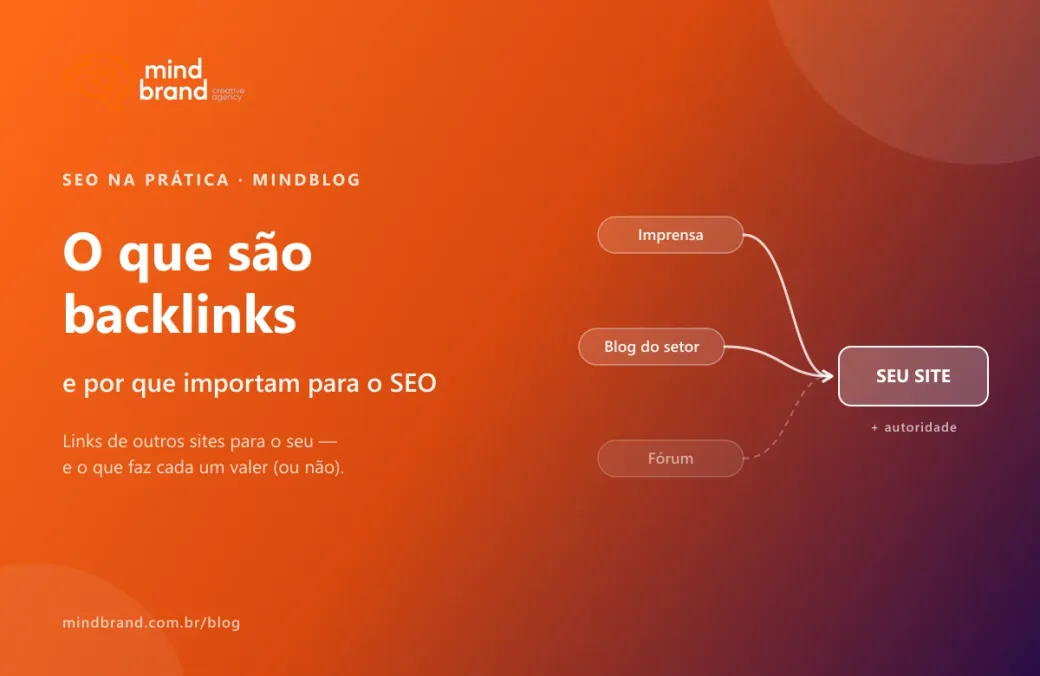
A backlink is a link on another site that points to yours. Google treats each one as a vote: when a relevant, trustworthy page cites yours, it helps show search engines that your content deserves to be displayed. After almost 25 years, links remain among the strongest authority signals, and the leak of Google’s internal documentation in 2024 made this even clearer.
This guide covers what a backlink is, what makes a link worth it (or worth nothing), the types and attributes, what to avoid and how to earn real links, without the shortcuts that generate penalties.
What a backlink is, in practice
Also called an incoming link or inbound link, a backlink is simply a hyperlink hosted on a domain different from yours. If your industry’s portal publishes an article and, in the middle of the text, links to an article on your site, you earned a backlink.
Not every link is equal. It is worth understanding the anatomy:
- Source page: where the link is. A report read by thousands of people is worth much more than a lost page with no traffic.
- Anchor text: the clickable words. They help Google understand what the destination page is about.
- Link attribute:
dofollow,nofollow,sponsoredorugc. They signal whether or not the link should pass authority (more below). - Context: a link within the body of the content, surrounded by related text, weighs more than a stray link in the footer or sidebar.
Why backlinks still matter in 2026
They are one of the main authority signals
Google uses links for two jobs: discovering new pages and estimating how much they can be trusted. A Backlinko study of 11.8 million search results pointed to the number of domains pointing to a page as the link-related factor with the highest correlation with good positions. It is not the total of links. It is the variety of different sites citing you.
The Google API leak confirmed the weight of links
In May 2024, thousands of pages of Google’s internal Content Warehouse API documentation became public. They indicate that Google evaluates, among other points:
- the quality and type of the source that links (not just the "domain authority");
- PageRank, which is still alive internally, with weight tied to the source page;
- anchor text spam: profiles with exact anchors repeated excessively are devalued;
- how recent or old the link is, and whether the source page remains active and indexed;
- local vs national links and the "neighborhood" of links around.
In short: a good link is an editorial link, from a real, relevant and living page. The rest tends to be worth little or to hurt.
Links and mentions also feed AI search
With AI Overviews, ChatGPT, Gemini and Perplexity summarizing answers, being cited and mentioned in trustworthy sources became part of visibility: not only the link itself, but the brand mention in the text. It is the same authority work, now also valid for AI-generated answers. We talk about this in Google changes: from SEO to GEO.
Discovery, indexing and referral traffic
Google’s bot follows links to find content. A page with no link pointing to it (internal or external) is hardly discovered and indexed. In addition, a good backlink brings qualified referral traffic: people who clicked because they were reading about the subject. This traffic is not a ranking factor, but it generates brand and new links over time, as we explain in does traffic influence organic SEO?.
What separates a good backlink from an irrelevant one
Before chasing any link, run the opportunity through this filter:
- Topical relevance: do the site and the page talk about your universe? A link from an engineering blog to an industrial company is worth more than a generic link from a "miscellaneous news" portal.
- Does the page have real traffic? High domain authority means nothing if the specific page is dead.
- Editorial position: is the link inside the content, making sense in the text? Or is it a footer link, a "partners" link or a signature?
- Natural anchor: the brand name, the URL or a phrase from the context: not your exact keyword forced in.
- Is it
dofollow?nofollowlinks have value (traffic, brand, diversity), but don’t pass authority in the same way. - Neighborhood: does the page link to decent sites? Or is it a list of casino, loan and miracle product?
Link types and attributes
Since 2019 Google uses rel attributes to classify links. You control the ones that leave your site; for the ones that arrive, it is good to know what each means.
dofollow(default): no special attribute. Passes authority and anchor. It is the link everyone wants to receive.nofollow(rel="nofollow"): "I am not responsible for this link". Treated as a hint. Common in comments, forums and some press outlets.sponsored(rel="sponsored"): paid, advertorial or affiliate link. Using this attribute on sponsored content is the correct path: hiding that it is paid is what generates penalties.ugc(rel="ugc"): user-generated content (comments, forum replies).
A healthy profile has all four. A profile with only exact-anchor dofollow is precisely the pattern that triggers alerts.
What NOT to do
Google’s Spam Policies classify as a link scheme any link whose main intent is to manipulate ranking. The most common:
- Buying or selling
dofollowlinks (money, product or service in exchange for a link). - Mass link exchanges ("I link to you, you link to me").
- PBNs: blog networks created only to link to their own clients.
- Mass links in comments, forums, directories and low-quality profiles.
- Guest posts at scale with optimized anchor, on sites that accept any topic.
- Widgets, infographics or templates with a mandatory exact-anchor link embedded.
If you inherited a profile with many toxic links and there is a sign of a manual penalty, there is the disavow tool in Search Console. For most sites, however, Google already ignores bad links on its own: disavow is for specific cases, not routine.
How long Google takes to give value to a backlink
There is a mismatch that confuses many people: Google discovers a link quickly, but takes much longer to trust it. This explains why a bought link sometimes seems to work at first, and why it almost never sustains position.
Discovery: days to weeks
Googlebot follows links all the time to find pages. A link on a page with authority, visited frequently, is found almost immediately; a link on a small site may wait a few weeks until the bot returns there. That is why backlinks appear in Search Console’s Links report a few weeks after going live.
Initial classification: weeks to a few months
After discovering the link, Google does a surface reading: topic relevance, context around the anchor, quality of the source page and obvious spam signals. This is where a clearly good (or clearly bad) link starts to reflect in positions.
Authority consolidation: several months to over a year
The slow part is trust. Authority doesn’t switch on all at once: Google follows the linking domain over time, whether it remains active, whether its link profile grows naturally, whether the content is maintained, whether there is a history of manipulation. In practice, the full effect of a good backlink accumulates over many months, along with the rest of the profile.
This pace is slow on purpose. If authority were instant, buying it would be trivial: a new site would grab a few dozen paid links and take off. The slowness is what keeps PBNs and link networks from gaining strength quickly.
Detection of buying patterns: continuous
Google doesn’t have a button that lights up "bought link". It crosses patterns over time: artificial link growth, repeated exact anchors, links with no real traffic, sites that sell links for any topic, networks of interlinked domains. A paid link can give a gain in the short term, but tends to lose value as these patterns become evident, and when Google starts treating a domain as a link seller, it discounts the value of everything that comes from there, including the link you paid for. Since 2022 Google states that it neutralizes a good part of link spam automatically, without a manual penalty: the link simply stops counting.
The conclusion is the same that runs through this guide: serious link building is a marathon. Nobody buys authority: it accumulates, and it takes time precisely so that you can’t cut the line.
How to earn real backlinks
There is no safe shortcut. What works sustainably, especially for B2B companies:
1. Create assets that deserve links
A page nobody cites gets no links. Linkable assets are usually: your industry’s own data and research, truly complete guides, calculators and tools, glossaries, case studies with numbers. Shallow content doesn’t attract links: it only attracts your own frustration. It is the basis of content aligned with the funnel.
2. Press relations and data for journalists
Journalists need sources, numbers and experts to cite. Responding to story requests, sending exclusive data and positioning yourself as a source in your niche generates links from outlets with real authority: the hardest to get and the most valuable.
3. Guest posts with criteria
Publishing a good article on a relevant site in your industry, with a link that makes sense in context, is still worth it. What isn’t worth it is producing dozens of generic texts for any site that accepts them, just for the anchor.
4. Relationships you already have
Suppliers, clients, trade associations, partners, integrations, sponsorships and events. A "who trusts us" page, testimonial, joint case: natural links that most companies forget to ask for.
5. Recover mentions without a link
Often the brand is cited without a link. Simple monitoring finds these mentions and a polite email usually converts a good share of them into a backlink.
6. Analyze competitors’ profiles
Who links to your competitors and not to you? This list (the "link gap") is the most objective starting point for a link building campaign.
How to audit your link profile
- Google Search Console (free): in Links → Top linking sites, you see the domains that point to you the most, the most linked pages and the anchor texts. It is Google’s official data and enough to get started.
- Paid tools (Ahrefs, Semrush, Majestic): show new and lost backlinks, authority estimate per page, anchors and comparison with competitors. Useful for ongoing work.
Look at three things: number of referring domains (not links), the relevance of these domains and the anchor distribution (mostly brand and URL is healthy).
How many backlinks do I need?
It depends entirely on the keyword’s competition. There is no magic number. What the data show:
- According to Ahrefs, about 66% of web pages have no external backlinks, that is, a few relevant links already put you ahead of most.
- It is worth more to have 10 links from 10 relevant sites than 100 links from the same site.
- Steady, natural growth beats sudden spikes in links.
Backlinks and brand go together
The stronger the brand, the easier it is to get links, and the more people search for and cite you spontaneously. Link authority and brand building feed each other. That is why MindBrand treats SEO, content and branding as one work, not as separate fronts.
Frequently asked questions
How many backlinks does a site need to rank?
There is no fixed number. It depends on the competition for the term. What weighs is the number of different, relevant domains pointing to the page, not the total of links. As about 66% of pages have no backlinks at all, a few quality links already make a difference.
Do paid backlinks work?
Buying dofollow links violates Google’s guidelines and risks a penalty. Ads and sponsored content are legitimate when the link uses rel="sponsored" and doesn’t try to manipulate ranking.
What is the difference between a dofollow and a nofollow link?
The dofollow (default) passes authority and anchor text to the destination page. The nofollow signals Google not to pass that credit, but still brings traffic, brand visibility and diversity to the profile.
Does a social network backlink count?
Social network links are usually nofollow, so they don’t directly pass authority. Even so they help: they generate traffic, expand the content’s reach and can lead to editorial links from those who discovered the material there.
Do directory links still count?
Niche directories, industry associations and legitimate local listings (such as Google Business Profile) have value. Generic directories created only for SEO, of the "register your site" type, don’t help and can hurt.
How long does a backlink take to take effect?
Google discovers the link quickly, in days to a few weeks, when it crawls the source page again. But trusting it is slow: the full effect on authority accumulates over many months, and for competitive terms consolidation can exceed a year, together with the rest of the link profile.
Sources
- Google Search Central: Spam policies (link schemes)
- Google Search Central: Qualifying outbound links (nofollow, sponsored, ugc)
- Search Engine Land: Unpacking Google’s massive search documentation leak
- Backlinko: Study of 11.8 million search results
- Ahrefs: SEO Statistics (pages without backlinks)
- Google Search Central: Link spam update (automatic neutralization of link spam)