
Branding: the emotional side nobody tells you about
In almost 25 years leading brand processes, I learned that the hardest part is never creating the logo, the name or the visual system. The hard part is the person on the other side of the table.
Nobody talks about this. Branding articles talk about archetype, golden circle, visual territory. Almost none talk about what really blocks, or unblocks, a brand project: what goes on in the mind of the person who built the company.
The business owner’s brand is not a logo. It is them.
For someone who picks up an identity manual, the brand is a set of design decisions. For someone who spent ten, twenty, forty years building the company, the brand is something else. It carries the first customer. The crisis that almost took everything. The name that a partner, a father or a wife helped choose at a kitchen table. The logo made in a hurry because it couldn’t wait.
Psychologists call this self-extension: we use what we create and own to say who we are, to others and to ourselves. For a founder, the brand is not an asset of the company. It is, in large part, their own identity.
That is why the sentence I repeat most in meetings is: a brand is not about the product. It is about the dream that was suffered to get here.
Why touching the brand hurts, and science agrees
When a business owner resists changing the brand, the easy reading is "they are stubborn" or "they are attached". It is not quite that. It is how the human mind works, and behavioral economics has already mapped the mechanisms:
- Endowment effect. We assign more value to what is ours simply because it is ours. Your company’s brand is worth more to you than it would be if it belonged to someone else, and that is not irrationality, it is the default.
- Loss aversion. The pain of losing something weighs almost twice the pleasure of gaining something equivalent. Changing the brand is felt first as a loss (of what exists) and only afterward as a gain.
- IKEA effect. In a Harvard study, people valued about 60% more the objects they assembled with their own hands than identical objects made by someone else. Whoever built the brand values it for the effort embedded in it. And here is the delicate part: accepting that the brand "no longer works" can sound like accepting that years of effort were in vain, and the mind refuses that, because nobody wants to conclude that their own work wasn’t worth it.
- Nostalgia. Changing the brand may feel like erasing a chapter of one’s own history.
None of this is weakness. It is the yardstick with which anyone measures what they built. A good branding process counts on this from day one: it doesn’t try to convince the business owner that they are wrong for feeling it.
The emotional curve of a rebranding
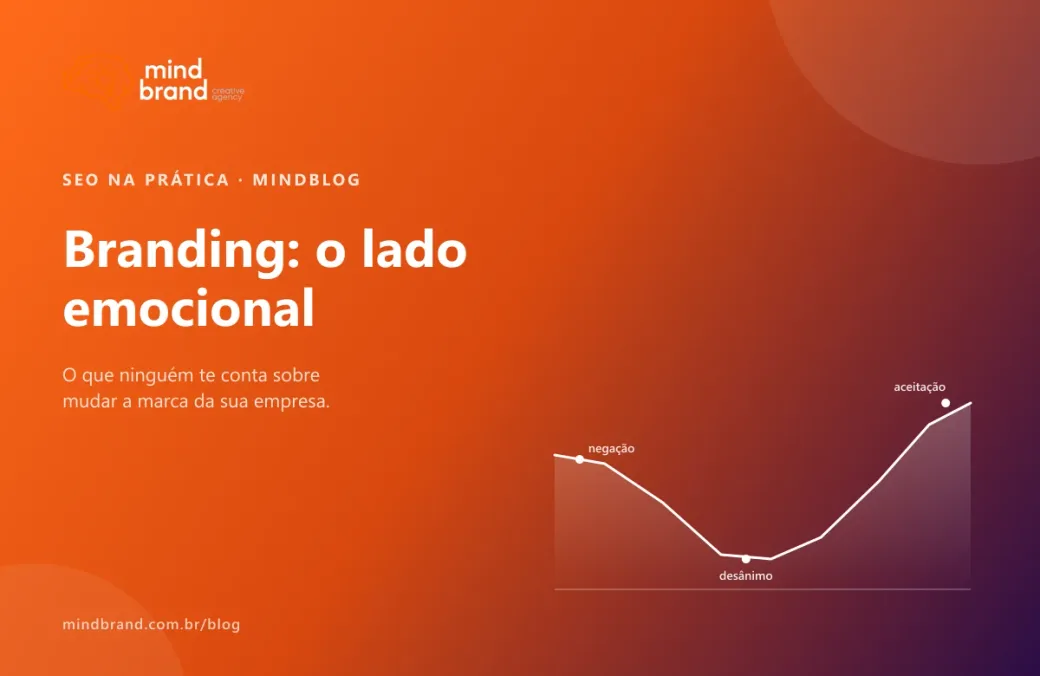
Psychologist Elisabeth Kübler-Ross described, for grief, stages that change management later adapted to the corporate world: denial, anger, bargaining, discouragement, acceptance. In a brand process, this usually shows up like this:
- Denial: "our brand is great, the problem is the promotion."
- Anger: "you don’t understand what we built here."
- Bargaining: "what if we just update the color and the typography?"
- Discouragement: "I think it isn’t the time, leave it for next year."
- Acceptance: "now yes, this is us."
An honest caveat: this is not a ruler. Kübler-Ross herself said that nobody lives the stages in order, and that many people skip some, or go back. It doesn’t serve to "diagnose" the client. It serves for the agency to understand that resistance is not the end of the conversation. It is a stage of it, and to walk together instead of pushing.
How I identify who is ready, and who is not
That was the most expensive lesson of these years. Not every business owner who wants a branding is ready for one.
Signs of those who are ready:
- Already separates "I" from "the brand": can talk about the company in the third person.
- Recognizes, without us saying so, that the brand has become too small for the size of the business.
- Has clarity about where the company is going in the coming years.
- Brings the team or the partners along, doesn’t decide alone in order to "sell" internally afterward.
Signs of those who are not yet:
- Asks for round after round of name and logo, approves and then goes back.
- The attachment to what exists is clearly greater than the will to change.
- There is no defined destination: "I want something more modern" without saying for what.
- The decision is stuck between partners who want different things.
When the signs point to "not yet", the right thing is to say so. A rebranding delivered at the wrong time is not implemented. It becomes a nice PDF in a folder and a worn-out relationship.
How long this takes
It depends on the contracted scope and, above all, on how ready the person is. A prepared business owner, with an objective-scope project, closes a branding process in about 3 months. A business owner who is not yet ready can take over a year, and, sometimes, the process doesn’t finish. The two cases below show the extremes.
Two cases that sum it all up
The names of the companies and business owners below were omitted on purpose. This text exists to deal honestly with a subject that many treat as a detail, and the minimum consistency with that is not to expose those who entrusted us with their own business, and their own history.
I have delivered brands I am proud of that never left the archive. And I have taken over a year on a process that "should" have taken three months. Both happened, and both were the right decision.
The process that was not implemented
The owner of a chain of vocational courses came to me wanting a rebranding. At the first contact, I said: you may not be ready for this.
There was a concrete problem beyond the emotional one. The company’s name had nothing distinctive: there were hundreds of businesses with the same name, and he had never been able to register it, because a competitor already had it. The brand he defended tooth and nail wasn’t even legally his.
Even so, he wanted to proceed, and we did a premium branding: senior team, market research and research with everyone who lived the brand: franchisees, the franchisees’ students, employees, partners and the business owner himself. In the brainstorm we reached 360 name possibilities. After crossing with what the research pointed out, 20 aligned remained. Of those, 3 were registrable with INPI and registro.br, and were registered.
We recorded a video presenting the three names to the business owner and the team. It was one of the most beautiful moments I have ever lived in a delivery: real emotion, people with tears in their eyes. He chose a name there, and we moved on to the logo stage.
In the middle of that stage, he called, canceling the process.
And that is fine. From the beginning I had said that maybe it wasn’t the time. The acceptance of that video day was real, but acceptance is not a switch that stays on. Something pulled him back, and his timing is his, not mine. The research work and the registered names are still there, ready, for when it makes sense.
The process that took over a year
Our job, at its core, is to identify the emotion, the meaning and the story of the current brand in order to carry that, somehow, to the new brand. When the business owner knows what they feel, even without being able to explain it, we have a thread to pull.
With the owner of a neighborhood real estate agency, this thread didn’t appear right away. She couldn’t put into words what she felt and gave no sign of an emotional bond with anything, not even the old brand. And when there is no emotional anchor at all, the process almost always heads toward failure.
Almost. In this case, we insisted, calmly, for over a year, until we helped her find what she herself couldn’t name. The process ended, she is satisfied, and the new brand is awaiting INPI’s approval.
A year for a branding seems like a lot. But the alternative was delivering a soulless brand on the "normal" timeline, and that one she wouldn’t have implemented.
The "ready-made logo" mistake
When Mansão Maromba, from Toguro, opened a public challenge to redesign the logo, dozens of designers showed up with the brand ready (closed layout, mockup, presentation) without ever having exchanged a word with him about what it means.
It is the opposite of a branding process. Arriving with the logo ready treats the brand as an aesthetics problem: "the drawing is ugly, let’s make a pretty one". But the "ET" there is not a drawing. It is the meme that became identity, that became business, that became the livelihood of many people. That is not redesigned in an afternoon. You understand what it carries before touching it: otherwise the result may be beautiful and not be the brand.
Without a briefing, without listening to the story, what is delivered is a logo. Not a brand.
How MindBrand conducts it
All our work starts with research, and not only on visual trends. As in the vocational courses case, we listen to those who live the brand from the inside and from the outside:
- The market and competitors: where there is room, what is already saturated, what territory nobody has occupied.
- Suppliers and partners: how the company is seen in the chain, what reputation it carries before the end customer.
- The customers: what made them choose, what they expect, what can’t change.
- The business owner: the story, the "why", what happened for the company to exist and what can’t be lost in the transition.
Only with this does the new brand carry the right symbolism and feeling for the next phase, aligned with the market, the customer and those who built it. And whatever has legal value (name, domain) already comes out of the process registered, not as a promise.
We don’t replace your story. We translate it to where you want to get.
Before deciding
If you feel your brand has become too small for the size of your business, but it still hurts to think about touching it: that is normal. It is exactly the conversation we know how to lead, without hurry and without running over what you built.
Start by understanding what branding is and how much it costs. When it makes sense, talk to us.
Frequently asked questions
How long does a branding process take?
About 3 months when the business owner is ready and the scope is objective. It can exceed a year when the person is not yet ready or lacks clarity about the destination. The timeline is less about the work and more about the moment of the decision-maker.
What if I hire the branding and, in the end, don’t want to change?
It happens, and it is part of it. The research and strategy work remains valuable even without the visual change: it often clarifies the positioning and postpones the change to a better moment. Names and domains registered in the process stay with you.
Do I need to change the name too?
Not always. Naming is a separate decision, and a name with history and recognition is usually an asset to preserve. But if the current name is not registrable, or already belongs to a competitor, that changes the conversation.
How do I know whether my brand has "become too small"?
Some signs: you avoid sending the website or the business card to a large client; the brand communicates a smaller size than the company already has; it doesn’t fit the new products or markets; internally, nobody is proud of it.